4/13/2012

Colorado Potato Beetles

Adult potato beetle.

Ozarks Gardening
Copyright 2012, Jim Long

The Colorado potato beetle is a major pest throughout most of North America. It was first recognized as a pest in 1859 in potato fields in Colorado. The beetle had previously only grazed on buffalo bur, a distant potato relative. But when pioneers who moved West, began planting large fields of potatoes, the beetle adapted to the increased food supply. In the wild, the beetle had to travel up to a quarter mile to find buffalo bur plants, but with the new fields of one crop, the potato, it had only to hop from plant to plant. By the mid-1870s, the potato beetle had expanded its range (at the rate of 85 miles a year),  all the way to the East Coast.

The arrival of the potato beetle caused farmers and gardeners to search for ways to control the bug. An infestation of potato beetles could wipe out hundreds of acres of potatoes in ten days. There were all sorts of inventions, mixtures and unsuccessful attempts at finding a solution. It was only by accident that a gardener who was painting his house, and probably in frustration at the beetles, threw the remains of his house paint on beetle-infested plants. The bugs died! The ingredients in the paint included something called, “Paris green,” an inorganic compound that was commonly used in wall paper, artists’ paints and house paint. Soon chemical companies were providing Paris green to farmers, to be mix with water or dust directly on to the plants. Within three or four years the beetles developed immunity to the poison and lead arsenic was added. Both compounds are highly toxic to other insects including ones that are beneficial in the garden, as well as dangerous to birds, wildlife and most specifically, to the humans who dusted or sprayed the plants (and to those who ate the potatoes later).
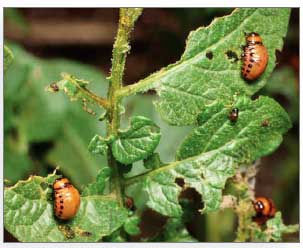
Potato beetle larvae, eating leaves.

The cycle continues to this day, with chemical companies readjusting their formulas about every three years as the beetles continue to evolve resistance. One method that large-production potato growers use, is to use an assortment of different pesticides, week by week as the season goes along, trying to stay ahead of the beetles’ adaptations and resistance to the other formulas. Today we know how dangerous lead arsenic and French green compounds were, but many of the newer formulas may prove to be as dangerous.
Larvae cluster together and devour leaves, sections at a time.

Home gardeners can easily prevent potato beetles from being a problem. My method of early planting of potatoes in late January to early February, always misses the emergence of the beetle. By the time I’m digging my potatoes, the beetle is just hatching out and searching for potato plants. But gardeners who planted later, combined with the abnormally early season, will likely experience potato beetles. In small numbers they don’t pose a problem and it’s easy to pick the beetles off by hand and drop them into a bucket of soapy water. Spraying isn’t necessary. To prevent them becoming a pest, be sure to plant potatoes early in the year next season.

Happy gardening!

3/26/2012

Free Back Yard Food


In the community where I grew up, most people foraged for food. My family, and all of our neighbors looked for spring food in our backyards, in the woods and along fencerows. Everyone knew morel mushrooms and wild asparagus. Wild greens were looked forward to and a point of discussion when neighbors met on the street corner. “I picked a mess of lambs’ quarters, dock, chickweed and violet leaves” was a common conversation starter in our town in spring.
Violets

Besides those plants there are lots of others, equally tasty. Violet leaves and flowers are edible (leaves in the greens pot, flowers for jelly). Tulip flowers make good “cups” for chicken salad on a plate. Red bud blossoms get tossed into spring salads. (The red bud is a cousin of the pea and if you like English peas, then you already know the flavor of red bud flowers). The red bud pods taste a bit like garden pea pods - just pick them when the pods are under an inch long, to be tender.

Red bud flowers work well in salads.

I still have kale in the garden that over-wintered. It’s now in flower and those are perfectly edible, along with the blooming stalks. Cornflowers, soon to be in bloom, can be added to salads. Dandelion greens are a favorite of many in the Ozarks (boil twice to remove the bitter, then add some butter or bacon crumbles) and the dandelion flowers make an outstanding wine.
Pansies go well in salads for some color.

Johnny Jump-ups and pansies are both colorful additions to a spring salad. The menfolk will grumble about flowers in their salad, but the women in the family will think they’re decorative. And flowers actually have flavor, as well! Sweet Williams flowers, for example, make an outstanding sorbet or jelly.
Lilacs make very tasty sorbet, ice cream and syrups.

Lilacs, too, are quite tasty. You can use the flowers, without the green parts, to make ice cream or sorbet. Lilac jelly and lilac pancake syrup are bit hits on the dinner table, as well. Plum blossoms, as well, are used the same way.
Roses in my rose cake. Recipes are in my book, How to Eat a Rose.

Roses of all kinds, as long as they haven’t been sprayed with chemicals (and not roses from a florist, which aren’t edible) are all tasty. Rose ice cream is a favorite flavor in India and you can easily make it yourself. Roses combine well with regular tea for a boost in flavor. Rose sorbet, rose jam, rose jelly and syrups are all easy to make. The more fragrant the rose, the better the flavor. Rose hips (the fruit of the rose) are also used for tea and jelly. (Lots of recipes are in my How to Eat a Rose book; also you'll find recipes on my Herb of the Year blog, too).
Roses in mint patch.

Be sure you know any of those flowers before you try eating them; consult a good book or on-line to be sure if you’re in doubt. Don’t eat flowers that aren’t listed as edible; for example, narcissus and daffodils are not edible.  But there are a lot of flowers that are edible and fun to eat.
Happy spring!

3/12/2012

Firestix and Free Enterprise

The Ozarks Herbalist column, for The Ozarks Mountaineer magazine.

When I was in grade school my friends were always telling me how lucky I was that my parents owned a grocery store. “You can eat all the candy you want!” one said. “I’d live on soda pop and peanuts every day,” said another.

The trouble was, I didn’t actually like soda pop, or simply, “pop” as everyone called. I’d rather have water to drink, or chocolate milk. And while I liked the overall idea of candy, one bite of a candy bar and I was no longer interested. Ice cream cones from the ice cream display, or slices of sharp cheddar cheese from the big cheese wheel in the back room - now that was another thing! But candy simply didn’t interest me.

Sometime in the 5th grade it dawned on me that I was missing an opportunity. Our school didn’t have vending machines like schools do today and many of my classmates were from rural areas, which meant they couldn’t easily stop at a store to buy snacks for the school day. So my first entry into the free enterprise system occurred to me on the school bus one day. I saw the connection between supply and demand and I realized I was the person to connect the two.

The candy called Firestix had just entered the market about 1957, in our store at least. It’s a candy that apparently is no longer available, not in the original form. The candy was about the size of a piece of taffy, wrapped in clear cellophane. It came one hundred pieces to a box, in a handy display and sold for a penny a piece.

I asked my father what his cost of a box of Firestix was and he told me it was sixty cents. Would he sell me a box for me to resell at school? He said he would and so the next day I set off to school with my first box of candy.

I was a shy kid and I’m not sure how I worked up the courage to start selling the candy, but I did. It didn’t take long before word got around on the bus that I was selling Firestix and since it was so cheap, my bus mates could nearly all afford the candy. (Later I learned that some of my classmates searched for pennies on the school ground, a few admitted to “borrowing” pennies from the bottoms of their mothers purses). The added bonus was, Firestix, as predicted by the name, was quite hot; it was made with a good dose of hot cinnamon oil. People in our community didn’t eat hot things, no hot peppers, no hot sauce - no one I knew had ever heard of a jalapeno pepper back then - so the taste was unusual enough it became a challenge for the boys to eat the sweet-hot confection. That first day I sold sixty-two pieces of my candy stash, enough to pay my father the sixty cents I owed him.

Soon kids were hunting me up on the playground at recess. “Do you have more Firestix?” they’d ask. When the bell first rang for recess, classmates would crowd around my desk where I’d set up shop with my box of candy and most days I’d sell the entire 100 pieces in the box before I got back home in the evening.

I quickly learned my classmates tired of the same candy each day and so I began varying the selections. Applestix soon appeared on the market and I began taking those to school.  Sales were best when I mixed a box with Firestix, Sour Applestix, Grapestix and Butterstix flavors. At the high point of my enterprise, I was selling 500 pieces of candy a week and my father was reordering at twice the rate he had earlier. He didn’t seem to mind that he wasn’t making any profit for his efforts but appeared to enjoy the fact I was in the candy business.

The downside and ultimate demise of my candy enterprise was the candy’s rappers. All of the candies were wrapped in clear cellophane, which on the school ground made no noticeable noise. But when stealthily taken out of a pocket during class and unwrapped, made a telltale noise much like the sound of a dry oak leaf being crumbled next to a microphone. That noise irritated the teachers and soon I began to get complaints. The principal put out a school-wide warning to all eight grades in our building that there was to be no candy eating during class.

The candy unwrapping noise subsided somewhat. Classmates soon learned to unwrap their candy at recess and keep it in their pockets, although the added lint and debris made the candy less than satisfying. The idea was to pop the candy into their mouths when the teacher wasn’t looking. But the children in the younger grades couldn’t resist. Knowing that within easy reach was a tasty piece of candy was a temptation too overpowering to be resisted. Some tried to very, very slowly unwrap their candy, which only drew more attention to the process. Others tried to muffle the noise inside their desks. None of those methods worked and within days, the principal came to me and said was forbidding all future sales of candy at school.

The candy business had been good. Since I had no inclination to eat the profits in candy, I had been pocketing approximately two dollars a week. My weekly earnings went into a jar in my room and eventually joined the profits from picking up and selling pecans in the fall and mowing lawns. I bought my first battery-powered transistor radio for $68 with the money I earned. I carried my portable radio with me everywhere I went after school, and it was my first connection to the world beyond my community. The radio added lots more to my life than any amount of candy I could have eaten, but more importantly it gave me my first glimpse into how small businesses operated.


Read more of Jim’s stories in his blogs: jimlongsgarden.blogspot.com, herboftheyear.blogspot.com and ozarksgardening.blogspot.com.

1/29/2012

February Garden


Copyright 2012, Jim Long

A mild January has gotten a lot of gardeners thinking about spring planting, even though the likelihood of going through February and March with continuing mild weather is pretty low. Most likely we’ll have the late winter snowstorms the Ozarks is known for. But, that doesn’t mean we can’t take advantage of the current mild weather, either.
Onion plants from Dixondale Farms.

My onions arrived from Dixondale Farms the first week of January they were planted within days. You may recall that last season I had a race between onion plants and onion sets (bulbs). I wanted to see just which method netted the fastest onions. The onion plants won the race by producing good-sized bulbs almost 2 weeks ahead of the sets. Of course I planted only onion plants this year.

So what can one safely plant right now? Onions, certainly because they’re very cold hardy. First plantings of lettuce can be sown now, as well. An old gardener in the town where I grew up in Central Missouri, always scattered her lettuce seed on the south side of her wash house, on top of a snow drift and she always had the first and most productive lettuce of anyone in town.

Potatoes, which I’ve written about before, are always planted in my garden in early February. By Ozarks tradition, peas should be planted by Valentine’s Day and I have mine ready. If you like leeks, you can plant those now. As soon as they’re a couple of inches tall, transplant them into rows, spacing about every 8-10 inches apart.
Larkspur do best when planted in very early spring.

Larkspur, poppies and bachelor’s buttons do well if planted this month. Scratch the soil slightly, scatter the seeds and lightly rake the area and they will come up as the weather warms. I scatter radish seed with the flowers to mark where I planted the flowers and I pull the radishes as they mature.

February is the time to prune grape vines. Don’t prune roses yet, wait until new growth appears in late March, but this month is the time to prune fruit trees. Once trees such as peaches and apples are pruned, you can give them their first spraying of dormant oil to prevent insect problems later.

Poppies, like larkspur, benefit from very early planting.

This is also an excellent time to till the garden. You can till under all the old mulch but more important, the tilling process exposes insect eggs that over-winter in your garden. Grasshopper eggs, larvae of cucumber beetles, cut worms and Japanese beetle grubs, all can be thinned by tilling early. Birds eat some of the eggs and grubs and even better, nights that dip well below freezing will kill the eggs and larvae. Besides, just tilling the garden will get you in the mood for planting.

You will find more gardening information on my other blog: http://jimlongsgarden.blogspot.com
Happy gardening, even this early!

1/14/2012

Grow Your Own Pie This Year

Add Some Berries to Your Garden

Blackberries begin ripening the first week of June.
There was a time when berry-picking was as ordinary as going to the grocery store is now. Come summer, families drove out into the countryside and picked blackberries along the roadside. People who had wild black raspberries or gooseberries, looked forward to picking fruit for pies, jams and canning. Now the roadsides are mowed and sprayed and most of the berries are gone. Store-bought berries, when available, are expensive and with few exceptions, shipped from South America. So why not grow your own berries?
Reaching into berry vines to pick isn't the painful thing it used to be, now with thornless vines.
The University of Arkansas has been developing hardy, thornless blackberry varieties for several decades and several licensed nurseries grow and sell them. These new strains of blackberries grow two to three times the size of wild ones and don’t carry the disease that many wild blackberries have. Wild blackberries are often deformed or shrivel before fully ripe from a berry disease. These new thornless varieties are resistant to those diseases. The thornless berries are big, the seeds are very small, the flavor is excellent and the vines are completely thornless. Add to that, they’re easy to grow. My favorites are ‘Arapaho’ and ‘Apache,’ both thornless berries that are great tasting.

Smooth vines, no thorns at all means no scratches, no pain when picking.
Both red and black raspberries do well all across the Ozarks region but don’t plant them together. Growers recommend keeping black and red raspberries at least 60 feet apart but both can certainly be grown on the same property. I keep my red raspberries in rows beside the blackberries and the black raspberries off to themselves. My favorite red raspberries are Heritage, which you mow down at the end of the year since they produce berries on new canes, and Lauren, which, for me, produces an early crop and another one in late summer.
Red raspberries produce for a month or more in summer. Some varieties produce 2 crops a year.
I’ve ordered berries from Pence Nurseries in northwest Arkansas many times over the years and they’re always very helpful in making recommendations. Find them here: www.alcasoft.com/pense/ They are a family business and you’ll need to call and leave a message that you want to order. They’re very prompt and will call you back at the end of the day to take your order. They sell grape, tayberry, gooseberries, currants, many varieties of black and red raspberries and several kinds of thornless blackberries.
The Pence family, from their website.
Berries require full to mostly-full sun, average garden soil and will benefit from being on a fence although it’s not necessary. Some, like Heritage red raspberries, often produce a few berries the first year but will produce a full crop the second year. Other berries produce a small crop the second year then are bountiful every year after that. Happy gardening!
Grow your own blackberry pie this year!

12/20/2011

Homemade Crackers YouTube photoshoot

The focus of the video is my Homemade Crackers and Easy Dips with Herbs books.

You've probably heard me mention before that we have aYouTube/longcreekherbs channel where we post videos of my recipes and books. Check it out if you haven't. Yesterday we filmed 2 more videos. That's the easy part, the editing and pasting it all together is the harder, and more creative part. Thankfully, my job is to stand in front of the camera and let David Selby and his associates do all the work. Here are some views of the photo shoot from yesterday. The end product will be 2 videos, one that will be about 3-4 minutes long, where I'm showing my friend, Makala, how I make cheddar crackers. The other is a 2 minute video telling what roses are good to eat and which ones to avoid. (There's more about the Herb of the Year and the Rose, official Herb of the Year for 2012, on my Herb of the Year blog, here). In a few weeks the videos will be up on our YouTube channel, but for not they're "in the can" awaiting the editing process.

Makala is the daughter of one of our employees, Neva Milke. Neva is one of the 2 ladies who answers phones when you call us to place an order. Makala first came to visit Long Creek Herb Farm when she was 4 years old, with 19 other vacation Bible schoolers. She was interested in herbs and gardening then, and her interests continue to grow. I invited her to be a part ofHomemade Crackers with Herbs video taping and she was fun to work with. Here are some scenes from the kitchen and the crew yesterday.


I took this photo, looking down into the kitchen from my upstairs office. You can see the kitchen counter all set with our working tools, David and Ben are getting the cameras and lights set up.

Everyone just discovered I was taking their pictures, too.
David does lots of film projects. He intends to make movies but for now, does a great job doing videos. Ben, to the left, grew up with David. Ben is in the Army Reserves and is currently attending Drury University School of Nursing. Makala, standing on set at the ready, is a second year student at College of the Ozarks.
It takes a lot of tinkering with lights, sound, cameras to get everything working right.
I could have slept another hour!

Out of camera view, on the sunporch, I had backups of the crackers, the baked crackers, the unbaked ones and the roses for the what roses to eat video that came next.
And here we are in front of the lights, almost ready for the rose video. Makala was patient and fun to work with. David and Ben were loads of fun and very professional. David's production company does an outstanding job. All the recipes for the crackers and dips came from my books.
I hope each and everyone a pleasant and peaceful holiday season.

12/09/2011

Gold, Frankincense and Myrrh

The 3 wise men brought gifts of gold, frankincense and myrrh.


We’ve all seen those late night t.v. ads for, “Bring your old gold jewelry to sell - prices are the best in history.” The last I looked, gold was selling for $1724 per (Troy) ounce. I don’t really know what an ounce of gold looks like, but I know it’s a lot of money for not much to hold in your hand. Most everyone knows the story in the Bible of how the three wise men brought their gifts of gold, frankincense and myrrh. We know what gold is, but few people know what the frankincense and myrrh are.

Frankincense tears.

Frankincense is from the Boswellia tree and comes from Somalia on the southern coastal area of Arabia. It was used in ancient times as an incense, for embalming and as a treatment for depression. People used it in temples, believing the smoke from the burning incense would carry their prayers Heavenward. 
Myrrh "tears" meaning, drops of resin, caught from the tree after it has a cut in the bark.

Myrrh, a brown to red aromatic tree resin comes from Commiphora abyssinica (which is in the same overall plant family as the frankincense tree). It’s a scraggly bush-tree which grows in semi-desert regions of North Africa and near the Red Sea. It is considered a wound healer because of its strong antiseptic and anti-inflammatory properties. It has been used to treat wounds, bruises and bleeding as well as a treatment for swelling.

Frankincense and myrrh were once as valuable as gold.

Both frankincense and myrrh were burned, usually together, as incense and were deeply connected to holy places and worship. Even today in Catholic and Episcopal churches, you will find these two resins still burned as incense during special services. Back in Biblical times, these resins were extremely valuable, fully as expensive as gold. Harvested far from  Jerusalem, they were brought on the spice routes over long distances on the backs of camels. Everyday people couldn’t afford to buy them. The specific healing properties of both made them even more desirable. For a mother who had recently given birth, the two resins were even more useful and valuable.
Our Frankincense and Myrrh Incense Kit in a Keepsake box.

We use frankincense and myrrh today in much the same way as they were used in Biblical times, in medicines, incense and aromatherapy. With better growing conditions and faster and less expensive shipping methods, they are no longer equal to the price of gold. You can buy these in today’s world, for just a dollar or two per ounce.

Both frankincense and myrrh are created when multiple cuts are made into the bark of each plant. As the sap oozes out it hardens into a hard resin. The resin is collected into bags and sold. The cutting process, of not done to excess, does not kill the tree or bush and can produce resin for many years. It's a slow process on plants that grow slowly in desert climates. The resins are harvested by hand, the same way they were 2,000 years ago.
Our Frankincense and Myrrh Incense Kit in a Keepsake box.
If you would like your own Frankincense and Myrrh Kit, you can order one from my website. It's on special this month. Each kit contains a bag of Frankincense and Myrrh, a charcoal disk for burning the incense, a special tile for the charcoal, instructions, all in a keepsake wooden treasure chest. Order two for $25 or one for $12.95 plus shipping.